

Every roofing company in South Florida will tell you their product holds up in a storm. Fewer will show you the numbers.
After Hurricane Ian made landfall near Punta Gorda on September 28, 2022 as a Category 4 storm, the Insurance Institute for Business and Home Safety went out and counted. Not opinions. Not brochures.
Actual roofs, thousands of them, scored for damage after the wind passed.
The results are worth sitting with if you are weighing a roof replacement in Boca Raton, Delray Beach, Fort Lauderdale, or anywhere along the Palm Beach and Broward coast.
How IBHS Ran the Study
IBHS is funded by the insurance industry, which means it has a direct financial interest in knowing what actually survives a hurricane rather than what markets well. For the Ian assessment, researchers combined aerial imagery from NOAA and EagleView with street-level photography gathered by the National Science Foundation’s Structural Extreme Events Reconnaissance teams.
The sample was large:
- 3,646 single-family homes
- 327 light commercial buildings
- 133 multifamily structures including condos, townhomes, and duplexes
Southwest Florida was a useful test bed because the building stock is mixed. Some homes were original construction. Others had been repaired or fully replaced after Hurricane Charley tore through the same region in 2004. That gave researchers a way to see whether 18 years of code updates and product improvements had actually changed outcomes.
The Headline Numbers
Here is how each roof cover type performed.
| Roof Cover | Approximate Damage Rate | Notes |
|---|---|---|
| Metal | About 12% | Best performing category. Most damage traced to debris from nearby structures rather than the roof system failing |
| Tile | About 40% | Some damage was common, but significant damage was rare except on roofs over 20 years old |
| Asphalt Shingle | About 50% | Highest residential damage rate. Roofs 10 years and older were especially vulnerable |
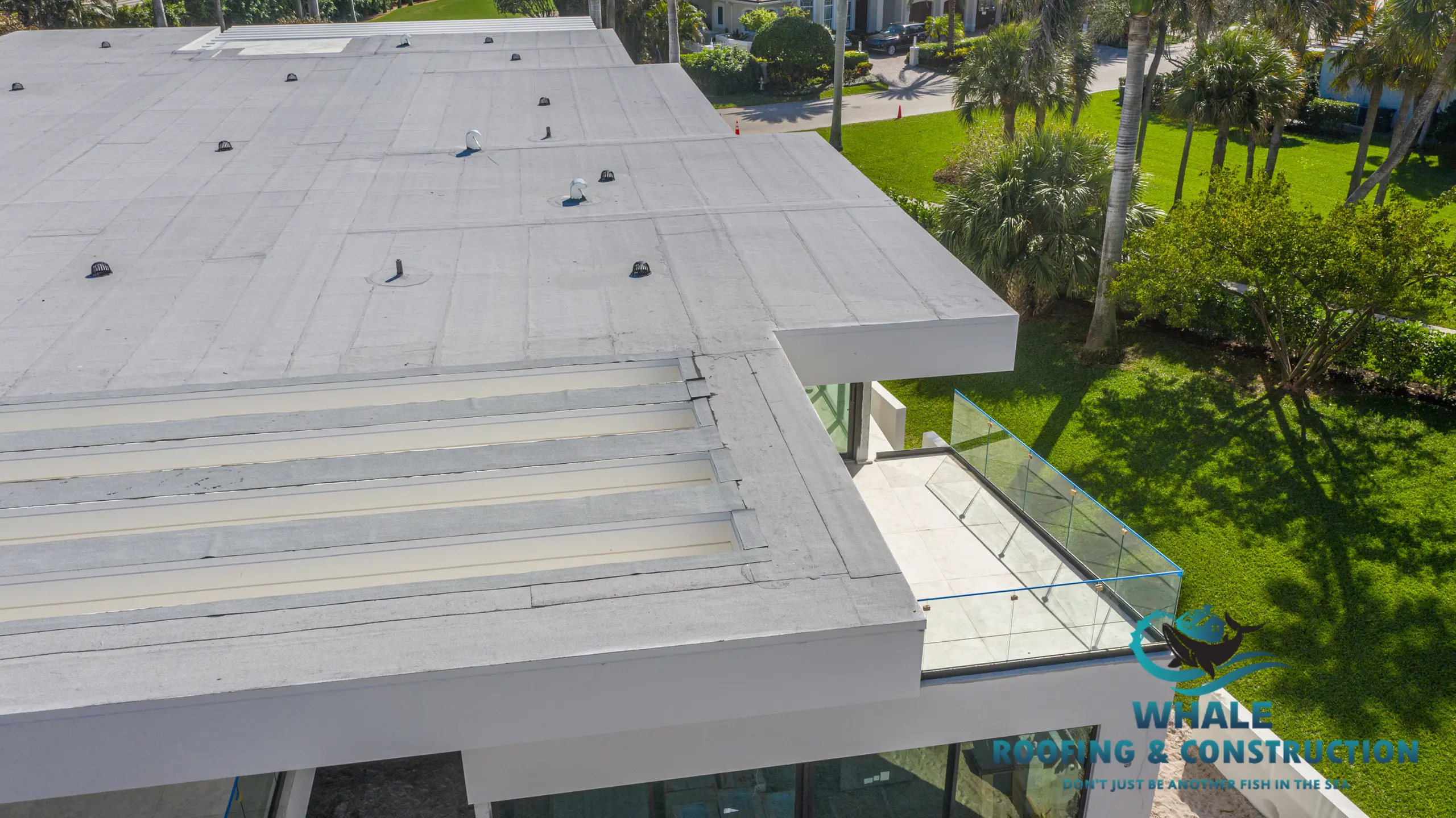
| Low Slope Commercial | Above 50% | Most failures involved flashing or coping at the roof edge |
Two findings stand out.
First, metal roofs did not just edge out shingles. They came in at roughly a quarter of the shingle damage rate. And the failures that did occur were mostly not the roof’s fault. IBHS noted that most metal roof issues resulted from failures of nearby structures, meaning flying debris from a neighbor’s roof, a carport, a fence, or a shed. The metal itself held.
Second, and this is the finding that should concern anyone with an aging shingle roof: the shingle damage rate was similar to what IBHS documented after Hurricane Charley in 2004. Eighteen years of product development, testing protocols, and code revisions, and the field results barely moved.
Why Metal Holds Up Better
The performance gap is not marketing. It comes down to how the systems are built.
Fewer pieces to lose
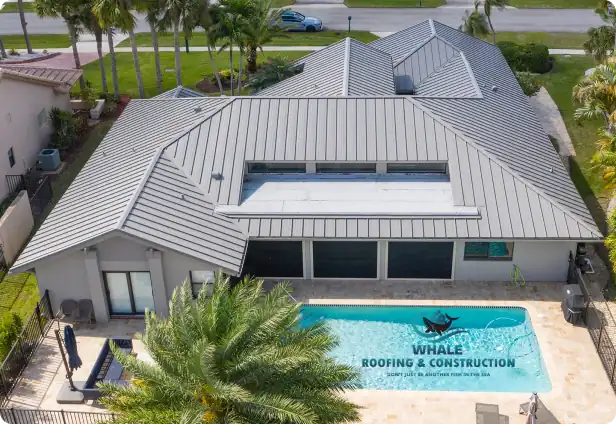
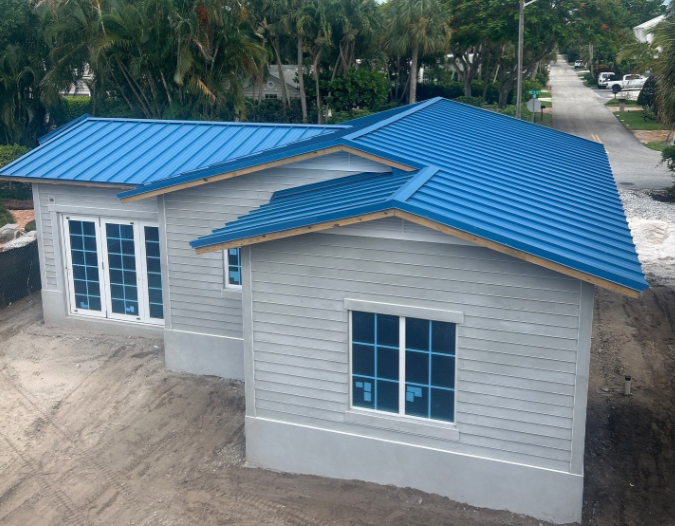
An asphalt shingle roof is thousands of individual tabs, each held by a handful of nails and a strip of heat-activated sealant. Wind only needs to lift one tab edge to start a chain reaction across a field of shingles. A standing seam metal roof is a small number of long continuous panels running from ridge to eave, so there are far fewer places for wind to get underneath.
Concealed fastening
Quality standing seam systems use hidden clips that lock into the seam rather than screws driven through the panel face. That removes hundreds of potential leak points and eliminates the exposed gasket failures that plague older exposed fastener metal.
Sealant is not doing the structural work
Shingle uplift resistance depends heavily on that adhesive strip bonding properly. Heat, age, improper installation temperature, and foot traffic all degrade it. Metal panel attachment is mechanical and does not age the same way.
Debris resistance
Metal panels take impacts that would puncture or tear other covers. A palm frond that shreds a shingle field usually leaves a dent in metal.
The Caveat an Honest Roofer Should Give You
Metal is not invincible, and the IBHS data is specific about the boundary.
Metal systems held up well in winds below 130 mph. Ian was a Category 4 at landfall with winds well above that in the core, and performance in the strongest bands was not uniform. No roof cover is a guarantee against a direct hit from major hurricane winds.
There is a second caveat that matters just as much. Roof cover is only one layer of the system. IBHS research consistently points to roof deck attachment, roof-to-wall connections, and secondary water barriers as the factors that determine whether a home stays dry and stays standing. A premium metal roof screwed to an under-attached deck is still a roof at risk. The panel is not the whole answer.
What This Means in Boca Raton and the Rest of South Florida
Ian hit the Gulf Coast. We sit on the Atlantic side. The lesson still applies, and the code context here is worth understanding.
Miami-Dade and Broward counties fall inside Florida’s High Velocity Hurricane Zone, the strictest wind-resistant building standard in the country. Products installed there need a Miami-Dade or Broward Notice of Acceptance and must clear the TAS 201, 202, and 203 test protocols.
Palm Beach County, which includes Boca Raton, Delray Beach, Boynton Beach, and Wellington, is not inside HVHZ. It sits in the wind-borne debris region under standard Florida Product Approval. That surprises a lot of homeowners who assume Boca Raton is covered by the same rules as Deerfield Beach a few miles south.
Practically, that means two things. Your contractor should know which approval pathway applies to your address, and you have the option to specify HVHZ rated assemblies even when the code does not require them. On a coastal Palm Beach County property, that is often a conversation worth having.
The Age Factor Nobody Wants to Hear
The IBHS finding on shingle roofs 10 years and older is the one we see confirmed on inspections every week.
South Florida is brutal on asphalt. Constant UV, sustained heat, salt air, and an eight-month rainy season age a shingle roof faster than the same product in Georgia or the Carolinas. A 12-year-old shingle roof in Boca Raton is not middle-aged. It is late in life, and sealant strips that have gone brittle will not perform the way the wind rating on the bundle wrapper suggests.
If your shingle roof is past the 10 year mark and you have never had it evaluated, that is the single highest-value thing you can do before the next named storm.
Metal, Insurance, and Wind Mitigation
Florida insurers price wind risk aggressively, and your roof is the largest single variable on the form.
A wind mitigation inspection documents roof covering compliance, roof deck attachment, roof-to-wall connections, roof geometry, and secondary water resistance. Each of those can move your premium. A newer metal roof installed to current code frequently scores well across multiple categories at once.
Credits vary by carrier and by policy, so treat any specific dollar figure from a contractor with skepticism, ours included. Get the inspection, hand the form to your agent, and let them run the actual numbers.
Florida homeowners should also look at the My Safe Florida Home program, which has funded grant-matched wind resistance upgrades for qualifying properties.
Is Metal the Right Call for Your Home?
Not always, and any roofer who says otherwise is selling rather than advising.
Metal costs more up front than architectural shingle, typically by a meaningful margin. It also lasts substantially longer, which changes the math over a 30- or 40-year horizon. Some HOAs and deed-restricted communities in Palm Beach and Broward limit roof cover types or require specific profiles and colors. Certain architectural styles carry tile better than standing seam.
The noise objection you have probably heard is mostly a myth. Metal over solid decking with underlayment and attic insulation is not appreciably louder in rain than any other roof. The clatter people remember comes from metal over open purlins on a barn.
What the Ian data should change is how you weigh the options. If storm performance is high on your list, metal now has field evidence behind it rather than just manufacturer claims.
Frequently Asked Questions
Does a metal roof guarantee no hurricane damage?
No. IBHS found metal performed best of all covers studied, with roughly a 12% damage rate after Ian, but performance was strongest in winds below 130 mph. Most metal roof damage that did occur came from debris striking the roof rather than the system failing on its own.
How much better did metal perform than shingles after Hurricane Ian?
About half of all asphalt shingle roofs in the IBHS sample showed damage, compared to roughly 12% of metal roofs. That is a substantial gap across a sample of more than 3,600 single-family homes.
Did tile roofs perform well?
Tile showed real improvement over the Hurricane Charley results from 2004. Around 40% had some damage, but significant damage was uncommon except on roofs older than 20 years. Tile remains a sound choice in South Florida when installed to current standards.
Is my Boca Raton home under HVHZ rules?
No. HVHZ covers Miami-Dade and Broward counties only. Palm Beach County properties fall under standard Florida Product Approval requirements, though you can choose to install HVHZ-rated assemblies.
Should I replace a shingle roof that has not leaked?
Age matters more than visible leaks. The IBHS data shows shingle roofs past 10 years were notably more vulnerable in Ian. A roof inspection will tell you where yours stands before a storm answers the question for you.
Get a Straight Answer About Your Roof
Whale Roofing and Construction installs metal, tile, shingle, and flat roofing across Boca Raton, Palm Beach County, Broward County, and Miami-Dade. We are licensed and insured under CCC1332756; our crews are in-house and supervised, and someone answers the phone 24/7.
If your roof is over 10 years old, or you want to know what a metal system would actually cost for your specific home, schedule a free roof inspection. No pressure, no obligation, and a clear recommendation either way.
Call (561) 408-4433 or request your free estimate online.