

Key Takeaways
- Do not choose a roofing contractor based on price alone. A lower bid may reflect missing insurance, inadequate supervision, cheaper materials, or hidden costs that appear later.
- Verify the contractor’s reputation and experience. Homeowners should narrow their options to roughly three contractors, ask for references, speak with previous customers, and review completed work in their area.
- Proper insurance is essential. Contractors should carry both workers’ compensation and general liability coverage. Workers’ compensation protects workers on the job, while general liability covers property damage caused during the project.
- The contractor’s labor warranty may matter more than a lengthy manufacturer warranty. Manufacturer warranties can have exclusions, may not transfer to a new homeowner, and can become invalid following hurricanes, hail, or other major weather events.
- Be cautious with large upfront payments. Paying most of the contract before materials arrive or the work is completed can leave homeowners vulnerable if the contractor delays the project, closes the business, or files for bankruptcy.
Introduction and Contractor Insurance
All right, this is David Walker, and I’m Derek Nier. This is the first episode of Contractor Confidential. Hopefully, a lot of episodes to come in the foreseeable future. I’m the owner of Whale Roofing and Construction. David is my CSO, my chief sales officer and manager. He runs point on all sales in our company. So what we’re going to talk about today is the roofing industry because I think that a lot of consumers and customers really don’t have a grasp on what’s going on when they’re getting bids from multiple roofing companies.
There’s a lot of nuances in these bids. There’s a lot of different factors in the way that companies are bidding roofs and modern-day roofing. As David has learned because he’s been doing it for about a year and a half now, there is a lot to overcome when customers compare different proposals. The first thing we want to address is the difference between roofing proposals. Something different is important to every client. Everybody’s looking for something different. The main question I lead with whenever I meet a new client is: What’s most important to you?
For some people, it’s price. For others, it’s the materials or production methods. And you really have to be careful out there because I can’t tell you how many times I see these different proposals that are in chicken scratch. I would say the most important thing is professionalism whenever you’re dealing with a roofing company. And that usually comes from looking at referrals, understanding the business, understanding ways to communicate that to clients. It really has a number of different facets. It’s funny because I’m going to say to all the homeowners out there, there’s a huge difference between a roofing contractor and a “Chuck in a truck” operator with a roofing license who does not carry workers’ compensation or general liability coverage, and/or he’s got a PEO policy, which we talk about all the time.
A PEO policy is tied to a personnel leasing company, and homeowners may not be able to verify exactly who is covered while working on the roof. One of the biggest concerns in our industry is price. Everybody wants the best possible price. You compare like Whale Roofing and Construction like our company that we’ve grown and built. We’ve been in business for six years. We have employees, we have trucks, we have gas, we have overhead, we’re paying general liability, we’re paying workers’ compensation, we’re paying a ton of overhead expense versus another company that you and I bid against all the time in Boca Woods. I won’t say the company’s name.
It’s one guy who’s the owner. He’s not really the qualifier. He doesn’t really have workers’ compensation. He’s using 100% subcontractor. And then, it’s really hard for you and I to overcome this price objection. Oh. Well, a company with proper insurance coverage will generally cost more than one without it.
And that is one thing that I always try to go through and explain with the clients is what could potentially happen if they don’t have the proper insurance. We’ll go ahead and dive into that a little bit, but as far as a PEO policy, basically states they’re should list every employee or worker covered while on the roof. W, if not every single person is going to be up there or they have unlisted day laborers or other workers, somebody falls off, unfortunately, that could become the homeowner’s responsibility. It’s definitely something that people need to understand. It’s worth some time just to take out every appointment to explain that to people. We actually created a rider. Well, I call it a rider.
It’s like a small brochure. We’re actually going to get them professionally printed, which is like homeowners can visit the Florida Department of Financial Services. You can type in a contractor’s name. And it will tell you if the policy that they have is real. Because a lot of people are you hand them a general liability or workers’ compensation certificate and how do it’s real? Customers are not actively like calling these companies and being “Is this contractor’s insurance valid, and is the license active?” Right? Which is why contractor fraud is so rampant.
And the HOA is not going to follow up on it either. The HOA’s primary responsibility is protecting itself from liability. They their job is to protect themselves from liability, which is why they have you fill the ARC documents and everything is a hold-harmless agreement. Another important clarification, the big difference between a general liability and workers’ compensation, a lot of customers don’t realize this, is workers’ compensation covers the employees that the contractor hires on the roof. General liability covers property damage, such as water entering the home during construction, that is general liability. It’s never happened so far with us. It has not happened.
We have never had a general liability claim to date., but. Just give one little knock real quick. Knock on wood. That’s like the one
Comparing Bids, References, and Contractor Credentials
I guess another big thing with sales and customers is they get super confused about the different systems that roofing contractors offer. That becomes even more complicated when you get with people that have eight bids compared to somebody that has two or three bids. And honestly, you can go down a rabbit hole if you do not understand roofing construction or project costs. Getting too many bids can overwhelm homeowners. And unfortunately, a lot of times they go with what they find to be the cheapest price on paper, but that doesn’t translate to hidden costs such as inspection fees, permitting, additional wood replacement costs. There are many variables, and homeowners need to know what to look for.
Before David joined the company, I handled sales myself, and I once met a homeowner who had collected 16 bids. I remember sitting at the table with a homeowner named Lisa and asking why she needed 16 bids. “I haven’t found anyone I like yet,” she said. I told her that 16 proposals from 16 contractors had left her overwhelmed. They all proposed different systems. Every salesperson that comes in your living room is going to tell you that their system is the best. And then you as the homeowner who doesn’t understand roofing, you’re a layperson.
How are you supposed to differentiate the 16 bids and then the prices are all variable too. I think number one, the best way to vet and bypass that entire process is just to start with referrals and references. It’s really ask people—people recommended by friends, family members, and neighbors, and then narrow the list to about three contractors. And then, of course, from each contractor, ask for references on work they’ve done. Talk to those people. If they’re a good roofing company, they’re, former clients should be willing to provide an honest review. And the big thing, too, is like we’re in Boca Woods.
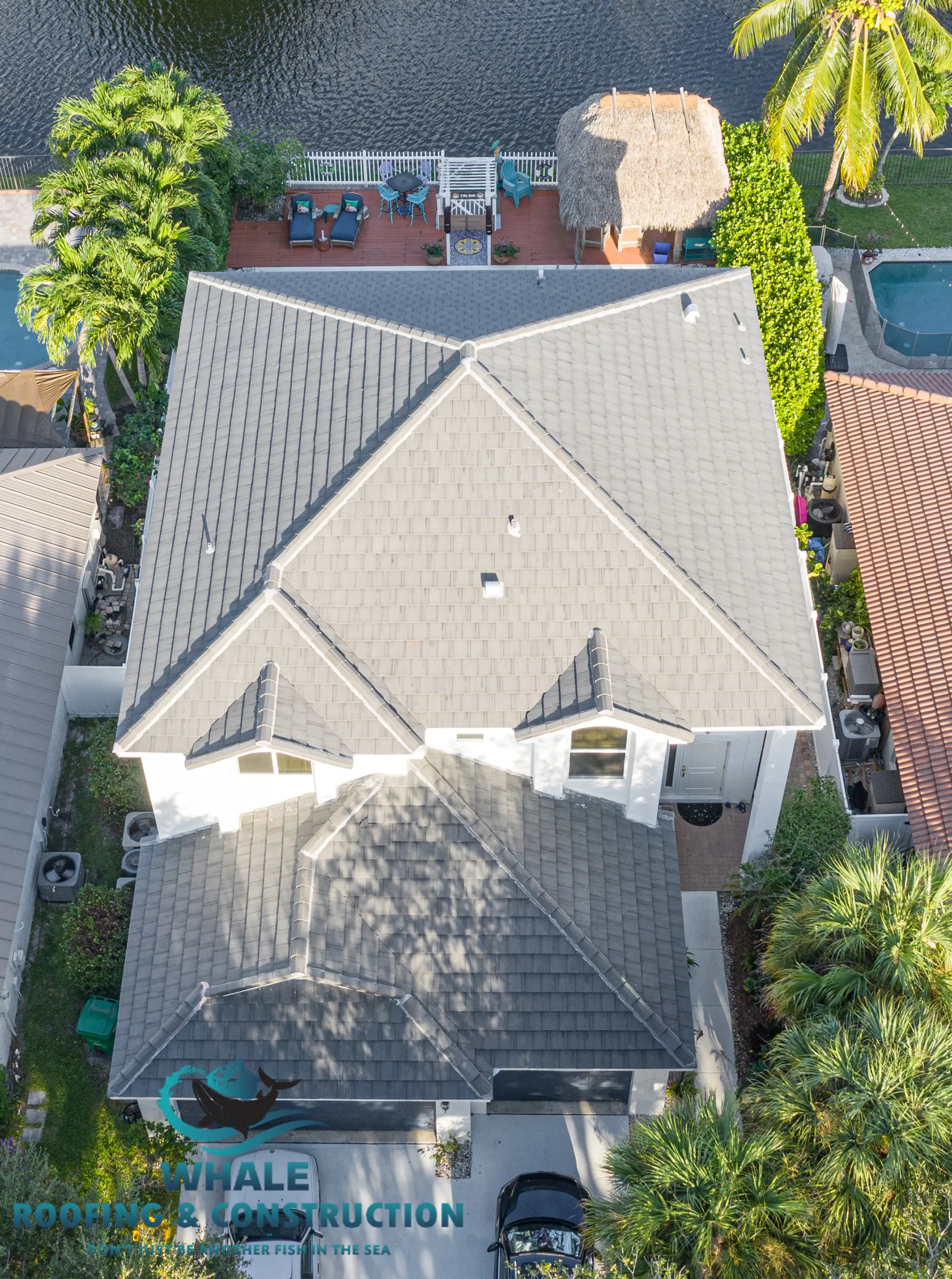
We’ve done like 40 plus roofs in there. Like you can see our work. So if you’re a customer and you’re getting a quote from let’s say three companies that are in Boca Woods, that makes sense. You’ve seen them work. You see the outcome of their work. It’s good. That is a strong sign of credibility.
We just lost a deal in Boca Woods to a company from outside the neighborhood. And it does not make sense to me as a contractor like we do good work. The price difference should not be the only deciding factor. We’ll we’ll get into roof-deck retrofitting later and that issue, but it’s like if you as a homeowner see a contractor doing good work in a neighborhood, right, that’s a really big green flag. And unfortunately, we already know what’s going to happen on that deal that we lost due to roof-deck retrofitting. And I think for them not understanding and having incomplete information as far as what other roofing companies are telling them, what’s going to qualify for insurance premium discount. What’s not, what meets code and what does not.
And it’s hard to vet that stuff if you don’t don’t understand the industry and you don’t spend the time diving into it online at least to look at the different standards that are required. The project may not work out well for them. We understand that we will not win every bid. If they go with somebody else you’re not going to get every deal but losing a deal because another company is not being truthful. That’s you want to educate the clients but you can only do so much. Contractors can only educate customers so much. Everybody that comes to your house is going to pitch you.
It’s your job to educate yourself to see who’s giving you accurate information. Because at the end of the day, There is a reason. Deals we lose, customers come back to us afterwards, like Justin Rizzo and a many other customers. I’ll use a big word for a lot that come back to us and they’re “We went with another contractor, but now my cousin, sister, son’s family member had a bad experience. It took forever. Things went wrong throughout the project. W we want to hire you.” Right.
It’s reflective of you are making one of the biggest financial decisions a homeowner makes. Oh, 100%. It’s a big expense. And the roof protects the entire home, right? If they don’t do a good job, a poor installation may leak immediately, but then in the future, you’re going to continue to have issues with it since it’s installed and then you are stuck dealing with the result. And on top of that, litigation may follow in some of those instances. The pain of just dealing with that cost, aggravation, everything else that goes along with it.
Returning to the sales process, what else should a customer look for? We talked about price being number one. That’s a big objection. Number two is going to be we talked about the insurance. Does the contractor carry proper general liability and workers’ compensation coverage? What other things do you think a homeowner should be asking the roofing contractor during the interview to make a decision? It’s one thing to hard it’s hard to find out, but financial standing.
We’ve seen some companies, and I won’t name any that are now out of business, but there are some companies that we’ve seen come through South Florida that were in bad financial standing, and literally they were selling roofing projects right up until filing for bankruptcy. That’s an ethical issue, but still, there’s a lot of people that lost their deposits. They were halfway through the project, came to a halt and now they have those costs. That’s one thing to definitely look into, see whether the owners have operated other companies that closed or failed. It’s hard to research, but it is worth researching when you’re spending $50 to $100,000 on a roof, and I say, similar problems are common in the pool-building industry. For sure. Pool construction faces many of the same risks.
They go out of business with. Left and right. The pool industry faces similar issues, right? I will say I’ll tack on that, too. A lot of customers when I was started my business, they were “Oh, Derek, you’ve only been in business for two years, three years, but like this company’s been in business for 25 years.” Roofing companies can change hands. They get sold to private-equity ownership. They get sold to people that don’t understand roofing companies.
You’re better off hiring a roofing company with an owner that’s active in the company that you can talk to that is active rather than going to hire a company that’s been bought by private-equity ownership. Because you don’t you may not know how the new ownership operates the business. The company may have had a strong reputation before the ownership change. Like to your point you used to be like well Derek you’ve only been business for three years like why would I hire you over a company that has been in business for 25 years? I’d be like well guess what if they go out of business tomorrow what is the warranty worth? It doesn’t matter how long a company’s been in business. You have to hire someone you trust, right?
And someone with a good reputation and someone that’s referred you.
Warranties, Supervision, and Payment Schedules
The big thing too that you brought up also is warranties. So let’s talk about warranties. Common labor-warranty terms for shingle roofs are five, eight, or ten years. Flat-roof labor warranties are typically five to ten years. For tile roofs, we provide a ten-year labor warranty. Other contractors may offer five, eight, ten, or fifteen years; it varies. And then for metal roofs, we generally provide a 25-year warranty.
Manufacturer warranties are also important. When reviewing bids, customers should compare what the labor warranty covers and what the manufacturer warranty covers. Both labor and manufacturer warranties are important. But I think it’s something that people don’t realize that pretty much those warranties may no longer apply whenever you have a major weather event such as a hurricane, tornado, or hailstorm. The warranties may no longer apply after you have that. Manufacturer warranties are most likely to come into play within the first six months after the roof is installed. If anything, the contractor’s labor warranty is often the most important.
I think a lot of companies use manufacturer warranties as a marketing tool to win customers. Some shingle manufacturers that offer 50-year warranties. Oh, yeah. I had one client the other day said 60, 70 year material. So like manufacturers spend tens, hundreds of millions of dollars on research on this. So they know the average person lives in a home for eight years, right? They know many homeowners do not transfer the warranty when they sell their house.
Well, we make our labor warranties transferable, but as far as manufacturer warranties, they are typically not transferable. T transferable. Like it’s a great marketing tool and like we use it for sure. Like Polyglass has a 30-year manufacturer’s warranty on their underlayment. Many underlayments also advertise long manufacturer warranties. Titanium PSU30 for 40 years. 40 Years.
Just so you know, it’s really important that you just pick a reputable roofing contractor upfront that will stand by their labor warranty because the contractor’s labor warranty may matter more in practice than the manufacturer warranty, right? And then on top of that, realize that if a major storm hits, with a major hurricane, tropical storm winds, your labor and your manufacturer’s warranty is out the window. It’s better that you hired a better contractor that installed the roof properly. And another selling point I always go back to is you already touched on it as far as ownership. There’s mainly you’re the owner. I run the sales division. Jacob runs production management.
And you can get a hold of us anytime. All three of us are always available Monday through Saturday if you need have any issue. Derrick’s always available if you need to speak to the owner. We’re not going anywhere. And that’s mainly trust that you’re conveying to other people is look. You have access to the owner of the company if you need it. I’m always available.
Jacob’s always available. We will stand behind the work and we do what we say we’re going to do. And then remember We also have supervisors on our job sites. English-speaking supervisors. A lot of companies will tell you they’re great and they’re going to do this and they’re going to do that and their time frame. They’ll send 20 dudes out to your job. They may begin the tear-off without a supervisor, tarps, or protective plastic sheeting.
They will damage your property and that can be difficult to evaluate during the sales process. But if you let’s say you got a referral, you would know that we have supervisors. And you need someone there during tear off to supervise that job. Just make sure the property is being kept clean and you don’t have neighbors coming over and. Causing any issues because HOA requirements vary. And you do not want to upset your neighbors obviously cuz they live next to you. Those are several of the main factors homeowners should consider.
Like price is a huge objection. That includes price, warranties, contract terms, and payment schedules. Oh, Another major concern is the payment schedule. We should also discuss large upfront deposits. Well, of course. And that’s the issue that you run into with these companies that are fly-by-night companies that have business one year and then next thing a homeowner may pay a 50% deposit and then be unable to reach the contractor. So then again touches on referrals, right?
References. Who do you have? But yeah, I have seen homeowners pay as much as 70% before materials are delivered. And 40% or 50% deposits, and sometimes nearly the entire contract amount upfront. And then basically oh well you do not have to pay anything at closing. Well you already paid everything. So a meaningful final payment should remain due at completion because you want to make sure that you get the permit and you want to make sure that everything’s done to the customer’s satisfaction and you had somebody there from the roofing company representative who has been there from day one know what’s been going on and they can go over all the details with you and anything that might have been left off or that you might want addressed, that’s the time to do it.
And if you paid everything up by that point, then can be a big issue. If it’s I say like out there, my customers, people watching, if it’s too good to be true, it may not be a good deal for you. If they’re offering you a great price, but then they want a 30% deposit, and then they want a 40% dry-in invoice, and you give them 70% of your money before your materials are delivered. And the majority of your dollars on a roofing contract are materials. That is a significant red flag. To your point earlier, we talked about like bankruptcy. Like the a recent company that went out of business in Florida was using new customer deposits to cover existing invoices and bills and guess what?
They took money from customers that were not completed and then they filed bankruptcy. And not to go into as far as homeowners insurance and all that, but that’s probably when you see the biggest, time period when you really need to be careful as a client on hiring a roofer because a lot of them go bankrupt in those periods because they’re waiting on the insurance companies to go ahead and pay out and the contractor may already have paid significant job costs for tarping, temporary repairs, material ordering, everything else. Especially after a hurricane in South Florida. That’s when you really have to be careful on who you’re choosing as a contractor. Those are the those are like the big things that homeowners need to think about and what we run into with objections. The other thing we’ll talk about is
Shingle, Tile, and Metal Roofing Systems
We’ll get into like the systems that we offer. We offer on a sloped roof. So in roofing there’s flat roofs and there’s sloped roofs. A sloped roof is your shingle roof. Standing-seam metal, concrete tile, and clay tile systems. Stone-coated steel which is metal that looks like tile. We do DaVinci, which is a composite product that looks like tile.
Wood shake is also used occasionally. Those are your sloped products. And then your flat roofing systems. Many homes also have a flat patio roof in the back. So What should customers consider when comparing shingle, tile, and metal roofing? Absolutely. Typical shingle wind ratings may range from about 100 to 140 mph for a typical CertainTeed, GAF Owens Corning.
We’re big on TAMKO because Titan XT offers wind-warranty coverage up to 160 mph. If you’re looking at tile, tile systems may be rated around 160 mph. And then the metal that we offer through dynamic metals, whether it be standard Galvalume or aluminum, may have approvals at higher wind pressures or equivalent design criteria. U, shingles are primarily water-shedding. Tile is also a water-shedding system. A properly installed standing-seam metal roof is designed to be watertight. Of course, the underlayment’s much more important on a shingle or tile roof than on a metal roof as the water should never get underneath.
If you need to go ahead and do a soft-wash shingle and tile roofs. Metal roofs should not be walked on unnecessarily, but tend to shed dirt more easily. It really is no upkeep with metal. In terms of pricing per roofing square, you’re looking at roughly $550 to $650 per square, which would be 100 square feet. Tile, you’re looking at around $1,000 per square. Metal around $1,150 per square, and then you’re probably looking close to $1,300 per square for aluminum. There is a price difference, but metal roofs last up to, 35 to 50 years and are often treated as lifetime systems.
Shingle roofs 15 to 25 years. Tile roofs 25 to 35 years. And that’s just what they should last to. That’s not according to what insurance says cuz insurance I just heard today in Texas they were saying shingle roofs if you have a shingle older shingle roofs may face stricter insurance requirements. The discussion then turns to low-cost synthetic underlayments. Low-cost synthetic underlayments can be very thin they use them in states like Texas. They sell synthetic in Florida.
Actually after the West Coast hurricane they were installing synthetic. To illustrate the pricing difference Like we’ll just throw this out for people to understand. Like a higher-grade roll may cost around $75, while a low-cost synthetic roll may cost only $18 to $22. And it’s literally like a piece of paper that you can literally tear. Like there’s just no right. Texas does not have a statewide roofing-contractor licensing requirement. So Texas does not have a statewide roofing-contractor license requirement.
So that’s where I’m from. So there’s different standards wherever you go. So I want to say also a big thing David just hit about the water the difference between waterproof and water-shedding materials. So concrete tile is permeable, so water can travel beneath the tile. If you actually went outside your tile roof and you had a concrete or clay tile roof you may see openings at the eaves known as bird stop, also called an eave enclosure. And you’ll see drainage openings that allow water beneath the tile to exit. In South Florida, some people jokingly call it an iguana stop.
Iguana stop. But I would say that like per what David’s saying the wind speed ratings people are like why would I upgrade? Well I’ll tell you why. When David worked the David used to be a public adjuster and we used to we went to Florida’s west coast after Hurricane Ian. Ian. All the metal roofs were still there and all the houses with metal roofs were doing very well in terms of you got to remember like I tell people all the time. In hurricanes debris is often a major source of hurricane damage.
It’s not necessarily the roofing system failing. The roofing system will fail with shingle roofs and tile roofs if wind speeds go above the threshold. But ultimately If you have a tile roof and it’s brand new and it’s foam down, it’s 160 mph system and a large 25-foot royal palm gets uprooted and slams into your roofing system. Well, guess what? It does not matter that you got 160 mph on that roof. I saw sailboats on top of houses and houses on top of houses. Cars in front of people’s yards.
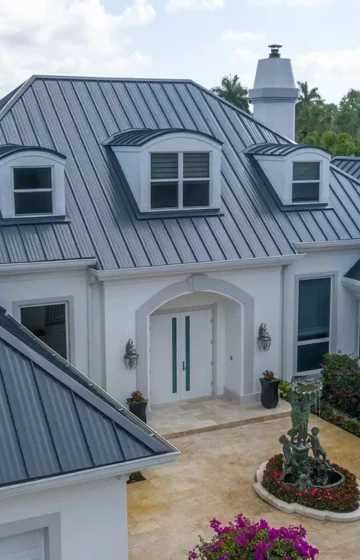
It doesn’t matter what type of roof you have at that point. It’s going to get damaged. I think like if you’re a homeowner, there’s a lot of customers that we do in Boca that are really between tile and metal. And We do not want to upsell customers if they’re not interested in tile or metal. But metal is by far the most superior system. And I think the main reason some people choose tile instead is aesthetics of a high-profile barrel tile. And they just like how it looks.
They have arch windows. It’s a traditional look. Metal has a more transitional or contemporary look. But it really, like I said before, it depends. Everybody wants something different, right? Something’s more important to each person you talk to. Some people with metal, they think it’s like industrial looking.
I think that the new standing-seam metal roofs look very contemporary. There are lower-cost metal systems are also available like exposed fastener and you can do a 5V-crimp that you see a lot in Port St. Lucie up north. They are less expensive. They are generally less robust than a concealed-fastener standing-seam system. The only time I’m surprised when I get a client that calls and said, “Oh, I need a new metal roof. I need you to replace my old one.” And I go out there and “Oh, okay.
It’s a corrugated metal roof. That makes sense.” Yeah. But I rarely meet someone who needs to replace a properly installed, “Oh, I have a 26- or 24-gauge metal roof and I need this replaced.” Mhm. Hasn’t happened to me yet. And then the other thing, too, is like when you’re a customer and you’re looking to buy a metal roof, like pay attention to the material specifications. Pay attention to the quality of material that they’re trying to sell you. Because there’s different gauges, there’s different aluminum thickness, there’s different the way that the panel is painted.
I guess we could dive into materials a little bit, but that’s pretty much the gist of like what the differences between the systems are. David talked about shingle
Underlayments and Material Quality
Roofs. There’s a bunch of players in the shingle roof game. There’s Owens Corning, there’s IKO, there’s TAMKO, there’s CertainTeed, Atlas. There’s a lot of different companies, but the big thing for shingles, like what David said, is that TAMKO Titan XT and certain competing shingles offer higher wind-warranty ratings. And TAMKO also offers a what, a 20-year warranty. 20-Year warranty on that and underlayment also. Shingles are a cost-effective system and they look good and they’re very, very popular around the US.
T so much in South Florida. But it’s a great system. I don’t know if you want to talk about tile a little bit, the underlayments that we offer. In Broward County, we offer Polyglass Polystick Polystick TU Plus. It is. Good system. If we do get a lot of people that are looking for a two-ply system.
In that instance, it’d be a Polystick MTS Plus and then you have a Polyglass TU Max. As far as Palm Beach County, we’re looking at Titanium PSU30 and this thing’s not ripping no matter what. And that’s the main thing. I’ve had some big bodybuilders try to rip this stuff. Body’s been able to yet. I don’t think we’ve had a single problem since you started using this. I’ve been using BS30 for three years and we’ve never had an issue.
And I will touch on it. The reason why we use different underlayment systems is because Broward and Miami Dade are both considered HVHC zones. So they are under Miami date code whereas Palm Beach County, Martin County, all under Florida building code. So each product has its own NOA which is a notice of acceptance and in that they stipulates what products can be used with what roofing system. So there is an upgrade also that we do offer for tile. It’s a certainteed fltastic SA cap. This is what we consider our Rolls-Royce of roofing systems.
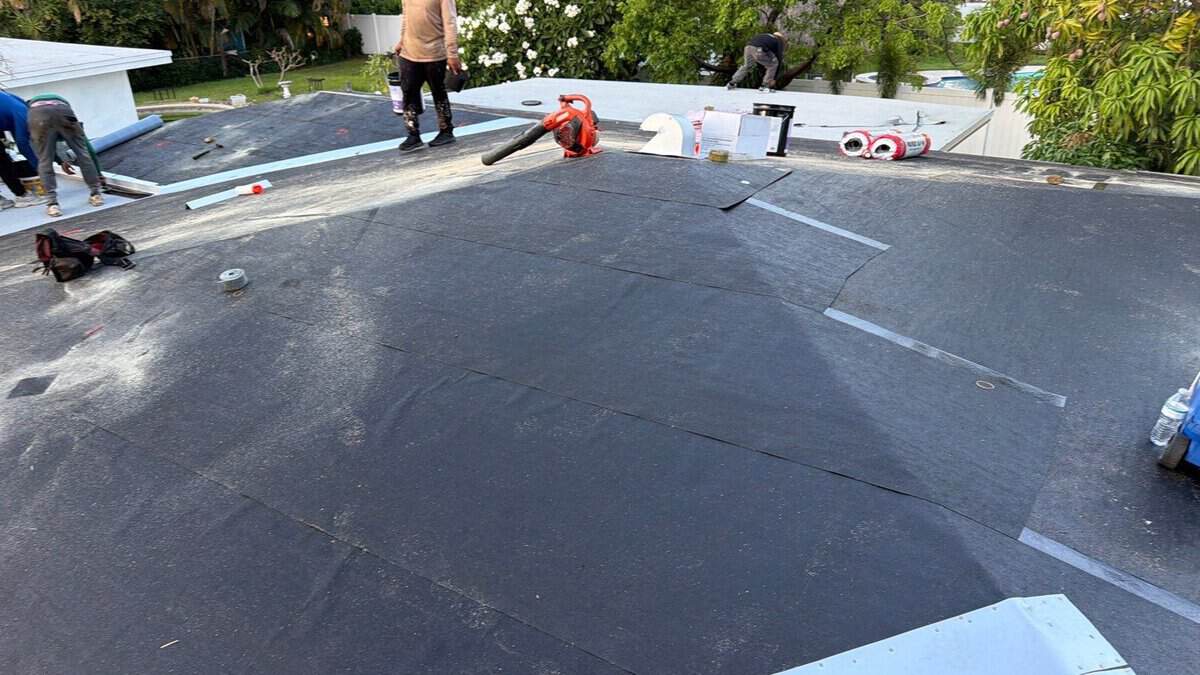
This stuff, this is also what you use pretty much whenever you’re looking for a cap sheet on a flat tile or sorry, flat roof. And really, in my opinion, this is better than a two- ply system. You’re not ripping this and you can literally leave it there for 20 years and not even put tile on it, and you’re still going to end up good. What do you tell customers when they’re “David, why are you selling me a PSU30, but another company’s offering me a TLY?” What’s the difference between the two ply and your underlayment? Like how do you overcome that? There are a lot of contractors that still go out that are a little more old school and they used to offer what a 90 lb felt which is not a self- adhering system which these all are self- adhering. They adhere directly to the plywood decking nail and tent tagged every four to six inches.
It used to be a 90 lb felt which was not self- adhering. You would have to tape the seams because it doesn’t fasten down to the decking. W, the analogy I give to people is if you have a cut on your finger, you’re not going to put two band-aids over your finger. But if you put a piece of paper over it, then of course, yeah, you need to put an extra layer of tape around it to adhere. I think that’s the simplest analogy rather than just diving into it and all the different code changes they made the past 10 years. That can answer your question as far as. I want to tack on that a little bit too.
So David just said that a lot of these underlayments that we sell now are self-adhering. Self-adhering is a new game that’s in the last 10 15 20 years. It’s become super popular in the last 5 years. OG original gangster roofing was always done with hot tar. So my dad was a roofing guy in the 60s and 70s 80s. They actually did crazy stuff with like rocks, builtup rock systems, all this all this stuff. Ballasted roofing is what it’s called.
But essentially what they used to do with slope roofing in 80s, 90s, 2000s is you’d tear the roof off, you would install 30 pound felt with tags and nails, and then you got the guy come out with the big kettle and there’d be a guy down on the roof the ground putting hot what they call them, I’m blanking on it. Say hot tar. Hot tar. Into the kettle. It melts and then there’s a guy on the roof that’s literally mopping with a mop. With they with a yarn and a pole and they mop the hot tar and then they put the roll down. Then all the neighbors are walking around with a mask on.
It’s not the It’s not the most lovely smell in the world. The big thing too then is this product, this granulated product. I don’t know which camera I’m showing this to. They used to mop two versions of this. They used to mop a 90 lb felt which you said earlier which is like a paper and they used to mop this granulated cap sheet tile again waterproof or permeable, so it goes underneath the underlayment’s most important in a tile roof. So when they hot-mop the roof will last 30 40 years. I think that’s better than a two-ply system anyways because.
Yes. Unfortunately a lot of these underlayments you can still even if they’re self adhering you can still rip them. But it’s an easier system. It saves you on labor because there is additional labor putting on another roll. So I feel like it’s a less expensive system, less labor. I’m a simple person. I like to keep things as easy as possible.
It’s a solid roofing system. Contractors confuse homeowners. The thing is like what you talked about that tape analogy. It’s like what I tell people with underlayments. It’s like if I show you an underlayment, like what’s like Polystick TU Plus for example, and this is one ply of Polystick TU Plus, and I can literally just like. Do this to the material. Don’t get me wrong, Polystick TU Plus is still a good product.
We use this in Broward. It’s a good product. But if I take Titanium Titanium PSU30 and I take it in my hands and I cannot tear it for any reason, like it’s rubberized, this is how it’s going to perform on your roofing system. And then to go if you use two pies of an inferior underlayment versus one ply or one layer, two layers versus one layer of a great underlayment. It’s really hard to like explain that to the homeowner. Well, a lot of times what happens is the pallets of tile, each one is 900 lb. There is going to be a little bit of give and take.
Might slip a few centimeters. You have a bunch of up walking around the roof carrying materials. Somebody scrapes it up with their boots, makes a cut into the underlayment. All they’re going to do is go up there and just put roofing cement over it and move on. It’s really not fully adhered to the decking once you do that. By the way, they don’t tell you that. They don’t tell the homeowner that.
The homeowner has no idea. They just live in ignorant bliss till they get a leak like seven years from now. And then they screw up their drywall and they’re still under warranty and the roofer still comes out and takes care of it. But still, it’s a an unnecessary leak. Well, because roof companies aren’t going to go out and lay down a whole another level of underlayment just to fix one small six-inch hole. But that also feeds on to the other thing is you want to make sure that the roofing company that you hire, you have access to see everything on the roof. And that’s why I make sure to, reiterate this to the customers is that we take 4 to 600 photos through company cam.
And so at any point during the process so they don’t have to get up on a ladder themselves and go check out the project, we can send them everything so they see exactly what we’re doing at all times.
Wood Replacement Charges and Roof Deck Details
Oh, we forgot a big one. What’s that? Additional wood charges. Oh, the fun one. We’re going to we’re going to come back to this for a second. We were talking about sales and one of the biggest things with hiring a roofing contractor. A big one that you and I have dealt with and we deal with in the production process is wood charges.
Roofing companies, we will give you allocations or allowances for wood in your contract. We cannot tell what the deck is going to look the trusses are going to look the flashing, any of these things until the roof is opened. And. Even if you go in the attic, you still can’t tell what the decking is. You cannot tell. I’ll say that’s one thing that I do try to do with the customers. If they already have a idea that there is going to be some extra rotted out fascia or extra rotted out decking or they know the flashing is going to be rusted out, that stuff I can build into it into my proposal at cost and give them more.
And then offer a credit back if it’s not used. And that’s a good way and it’s a good selling point because it does save the customer money and then they aren’t looking at this big wood replacement change which has to be done per code has to be taken care of. So there’s no way to get around it but there’s just unforeseen things that go on with a roofing job. Same as any level of construction. Because like we don’t know if you have termites. We don’t know. A lot of these customers they’re waiting till like they’ve experienced several leaks.
The roof is five 10 plus years past the normal roofing life. We don’t know and we can’t take the risk to give you everything included. A lot of customers “Well, why can’t you just include everything in the contract? We just can’t do that because then we would be eating, right. The downside.” Well, and one thing, if a customer tells you they put a coating on it 10 years ago, guaranteed they’re going to have a lot of rotted out decking. Don’t paint your roof ever. Don’t use Americ Home Depot special products.
You’re going to just you’re going to pay less now. But when you do it, you’re going to pay for it. Times three, four, five, right? Because you were cheap in the in the on the front end. We had that condo building and pump and they wanted us to go ahead and put a new coating on there. I just stom we don’t do coatings. We don’t do any type of that and this is the reason why is it traps all the humidity and heat underneath the tile and with that the deck is going to run out very quickly.
Alas, Alasameir products are made to make your roof last longer, but they don’t tell you that it’s going to trap humidity and moisture underneath into the deck and rot the deck and the trusses out. When you’re hiring your roofing contractor, another big thing is make sure that you vet the additional charge. Well, I don’t call them additional charges anymore. They’re additional wood charges because we are not providing a additional charge. These are things that we have to do per code. And every contractor should have a sheet exactly what you’re paying per linear foot or square foot for any additional wood charges. And if they don’t, that’s a red flag.
That’s a huge red flag. If. There’s a reason why they’re doing that. They know that what they’re doing. So why aren’t they giving you that information? They’re going to call you in the middle of project be “Hey, sorry. Forgot to tell you that we didn’t include trusses and plywood and fascia in your price.
W it’s $10,000 more.” Right. And then you’re locked in with them. And then what are you supposed to do? Then you really don’t have any recourse. I guess maybe you could try, but it’s going to be extremely time intensive and, labor intensive in doing that. Beware of the additional wood charges additional charge game that contractors play. If the contract is not detailed well, it’s a red flag.
If there’s no contingencies for wood, that’s a red flag. If the contract looks like it was written by like a 15-year-old or through AI, that’s a red flag. Terms and conditions. Terms and conditions, red flag. Website, red flag. Little or no Google reviews, red flag. Let me touch on the just the website is I remember I had a client that ended up getting screwed by another company.
And they did show me the salesman guy or the salesman’s card when he dropped it off and it just said sales. Did not have a company name on it. Did not have any email address on it. Just the guy’s phone number. So and so sales. They said he was a good salesman though. But long story short, roofing company did a horrible job.
Didn’t replace a lot of the decking. I don’t know how they made it through their inspections, but she showed me their website and I’m looking at all the photos on the website and there’s snow all on the ground on all these photos. Oh my god, you told me. I remember. So they’re “Oh yeah, they said they’re based out of South Florida.” I’m “Every single photo has snow in it or has shows that is definitely not a house in Florida.” But, that’s, after the fact now they’re, fighting them and in litigation, all that fun stuff. Do not put yourself in this situation. Hire a reputable contractor, please, for the love of God.
So getting back to tile, we talked
Concrete Tile Options and Installation Details
About the underlayments. We’re going to talk about concrete and clay tile. The differences real quick. Technically, concrete tile is actually made in Florida. There are three manufacturers. I did not bring all three manufacturers brochures here today. There is Eagle, Westlake, and Crown.
Westlake has three plants in South Florida. Crown in Crown is used to be what’s the name of the company? Maybe they were Integra. They came back as a as a they were a big player in the 80s and 90s. They went out of business. They came back as Crown. And Westlake was Newpoint.
Westlake was Newpoint. So Eagle Crown, Westlake are the players in town for concrete. Clay Tile is not ultra popular in South Florida. It is more expensive than concrete. And remember the underlayment is more important than the tile. Miami date, Coral Gables, that’s. Where you see the.
Clay see clay tile. Palm Beach Island. Some communities in Boca like mandate clay. Clay is made predominantly in South America. There is like Altusa and Santa Fe and Verea and I could probably think of others. And it’s about 30 to 50% more in some cases 100% more. So alphllorlloresence, let’s talk about aphllorlloresence.
This is a term that does not get thrown around a lot to the consumer in the roofing industry. You want to hit on it a little bit? I’ll say there are you ask five different people what apheresence basically sources from and you’ll get five different answers. So the best thing I would say in my understanding is when the mortar is not oxidized correctly. You’ll see a deterioration in the color. It doesn’t come out the same color scheme. It is something that, we see it every once in a while, but it’s not that often or that common really.
D like what David’s saying is one aspect of it. It’s a concrete product. What Westlake and Crown and Eagle will say is that naturally occurring concrete products can rest, which means that they can bleed an under color. If the color is gray, dark gray, it can bleed white. And it’s normal because it’s weathering. Problem with for the homeowner is if it happens to you, guess what? They’re not going to cover it.
They’re going to tell you have to wait one to three years for it to weather out. Westlake, notoriously, we’ve had some issues with them with a florescent Eagle and Crown, not really, but that’s just something that people should be aware of when they’re buying a roof so they know it’s concrete product. Lately we’ve been pushing Crown and Eagle just because their customer service, but maybe we’ll get Joe on here and he’ll tell us why we should come back to Westlake and we why we love Westlake so much. By the way, Joe is the branch manager of Westlake. I love him. Why should you pick one or the other to be honest? They’re all the same stuff.
They’re all concrete. They’re all made the same way. The quality is like kind for the most part. Just different color schemes. Pricing can vary. Prices change, once every, say, four to six months. But as far as quality.
It’s all the same The other thing, too, is styles of tile. David talked about it earlier, the traditional like we call it the barrel tile or barrel tile. Traditional. S-tile, barrel tile. S-tile, barrel. Roll. And then your flat tile has become super popular with builders in the last like five to 10 years.
Super contemporary. It’s transitional. That’s like where the industry’s gone. A lot of people are really getting away from the S style. And it really depends on what the, house appearance is. Also, if you have very symmetrical windows, doors, and you’re looking at, even lines, I think flat tile looks better. Goes great with metal roofs.
If you have big arch windows, big arch doors, entryways, I think a high barrel style goes better with that. Just really depends what you like aesthetically. Say one other difference, if you have a high barrel tile or if you have a flat tile and metal roofs as well, you always want to move to a seven-inch gutter. The water runoff is going to be faster on those. It’s going to go out a little bit further. If you have a medium-profile tile, you’re perfectly fine with six inches. Just to add a note.
We don’t really do gutters. We sub that to a third party. Gutters are, we always recommend if you can afford it to go seven-inch gutters. They perform better than six-inch gutters. It’s not just one inch difference. One inch deep, one inch wide, too. And then downspouts are usually bigger, too.
There are 3×4, 4×5, whatever. That’s like the concrete tile spiel. Metal
Standing-Seam Metal Roofing, Insulation, and Ventilation
Roofs are like a whole different animal. There is I’ll throw this over here for a second. There’s a whole slew of metal underlayments. We’re going to run out of time, so I want to try to get through this if we can. You want to talk about the differences in like the metal systems that Dynamic sells? So they have about five different systems. Some of them are for commercial, but really all we offer is the DM Class 1500 and the DM Class 1000.
DM Class 1500 uses 24-gauge, 16-inch striated panels, mechanical standing seam. DMclass 1000 is still it’s a standing seam. Its mill-finish option is 26-gauge, while painted options are available in 24-gauge. So just a tidbit, As a general rule, 24-gauge steel is thicker than 26-gauge steel. But I’ll just say how as far as the DM Class 1500, which is our standard that we go with most the communities in Boca. What it is basically as you lay it out, you have 24-gauge, 16-inch-wide panels, inch and a half standing seam, and a stainless-steel clip is installed every 16 inches on center. And then once you put the next panel down, a seaming machine crimps the joint to create and a watertight seal.
It’s not moving for the next 50 years. I think that big thing for metal when you’re getting bids and proposals, there’s three factors what you just talked about. One is the attachment method. So that’s going to be your 1500, your 1,000, they have snap lock, they have mechanical seam, they have nail strip. Then you want to think about not without going into a rant, but essentially everything that we do is roll formed on site. So big truck comes to your house, they actually make the metal panels at your house. Cut it to the dimensions they need to.
To. So what happens is when we sell a metal roof, we send the roof report to Dynamic. Then they send a representative to the house. They perform what’s called a cut sheet. So they actually measure the entire roof. Once the cut sheet is completed, then Dynamic will then roll form and then fabricate the entire cut sheet at the person’s house. The big thing that we need to explain is like the way that it’s the coils are made is they actually paint them with a Kynar 500 paint.
We talk about that Sherwin-Williams has PVDF coating systems that they use in the industry and then it’s like the brand of the coil. Ultimately, the quality of the installation matters as much as the brand of the metal. And then the DM Class 1500 has the highest wind threshold. If you go nail strip, they’re literally just like doing a fastening nails through exposed holes and then putting the panel on. Whereas, when you install a clip, a stainless steel clip of screws every 16 inches, you’re getting hundreds and hundreds and probably thousands of screws on each seam. Which creates a huge benefit for you as the homeowner.
And then a lot of times we get into this like thing with like underlayments with metal, like metal underlayments don’t matter. They really don’t. It is important to have an underlayment, of course. But as far as if you’re going from a, a 30 mil sheet to a 60 mil sheet, doesn’t really matter. You should never have water penetrating. If there’s water getting underneath the metal, then it’s already faulty installation. If you have metal going underneath your metal roof, water getting under a metal roof, something was installed incorrectly.
Because it’s supposed to be 100% watertight. And then the thing is too, we talked about HVHZ, high-velocity hurricane zones require a fire-rated underlayment. You have companies that tell customers that fire-rated underlayments are better. What fire-rated underlayment means that if a house is on fire next to you or there are embers in the air and they were to land on your metal roof and burn through the roof that the underlayment would be like a fire safe and essentially last x amount of time longer before burning into your dwelling. We’re we don’t have fires in Florida. T many of them. Let’s Key West would be a good example of why you would definitely want a fire-rated system down there.
The houses aren’t really that close. In the other communities unless you’re town home or something like that. You see a lot of fire-rated underlayments in California, right? Obviously, or any state that can burn, where we can actually get fires, but companies use this fire-rated to like differentiate themselves or upsell themselves, which is a BS tactic that companies use. But ultimately like we sell Titanium PSU30 and then Titanium FR. Polyglass makes Polystick XFR. There are other companies that make other underlayments that are fire-rated and non-fire-rated.
At the end of the day like it’s better. If you get a good underlayment and you get DMCOS 1500 then you’re you’re good. You’re set. It’s another reason why metal and aluminum roofs are more expensive in Broward County than they would be in because this is a more expensive underlayment. Just so like to give you an idea like non-fire-rated underlayment’s 100 bucks a roll for 200 square feet. Fire rate underlayment is $135 a roll. It’s 150 square feet.
So it’s. Way more money. Way more money. That’s a big price difference for a lot of people. Especially between just because you’re in a different county. Another big thing I wanted to bring up too, metal roofs reflect heat. They have SRI, or solar reflectance index.
I don’t know if I’m saying it the right way, but the lighter the color of the metal, the more it reflects heat. I don’t think you’re going to find a huge difference though all that much between a, matte black metal roof and a dove gray metal roof. There is a certain percentage that they’re going to have reflectivity of course is higher on the dove gray, but as far as what you’re going to feel in the home, you’re not going to feel that much difference because it really comes down to your insulation. That’s really what cooling effect comes from. Insulation, R-value, which is thermal resistance. Really important for homeowners to understand this. Our value dictates insulating factor in dwellings.
Most new construction homes are blown-in insulation. We talk about this. We do sell this product. I brought it today. We also offer a reflective bubble-insulation layer. It’s an insulation sheet that goes underneath the metal roof between the underlayment and the metal. I don’t have the flyer for it, but.
Another option is a Solatube solar attic fan. We use this with metal roofs. We’ll sell it if you have a lot of heat issues. It is marketed with an R-value benefit. It’s a good product. I’d say probably 20% of people that get metal roofs end up putting that on there.
For sure. And then he has David has the other one. And then another thing we offer is Solatube solar attic fans. This is an additional upgrade if you want it. But what it does basically is it runs off solar energy. Takes the hot air out of your attic, that hot stale air, replaces it with the cooler air from outside, continuously runs, and it actually gives you a discount potential savings on electricity costs. It’s added benefit.
We have a lot of clients that love these. The number needed depends on the size and design of the roof. And it does, help get some cooling out and, went over that the other day cuz I had a client that wanted to store a bunch of their, just items in the attic. And I was just going through this. T that it’s going to make it’s not like your attic’s going to turn 70°. But it does, provide some cooling effect. And the good thing about those Solatube solar attic fans is you don’t if the solar fan component goes bad, the actual base is mounted to the roof, but you can actually just pull off the top and then.
If the top component is damaged, Solatube can provide a replacement. And it doesn’t require electricity. And Tax-credit eligibility should be verified at the time of purchase. So that’s like the big thing for now R-value insulating factor like the difference between metal and tile concrete obviously absorbs heat. So like if you put a piece of concrete on the ground and you touch it like 20 minutes in Florida sun it’s going to be hot. And the darker the color of the concrete the hotter it’s going to be. So you do get some benefit of using a lighter colored metal roof for sure I think the last thing we brought the TAMKO Titan XT shingles here.
We talked about a little bit earlier, but TAMKO Titan XT is a heavier-duty shingle than many competing products. It’s a heavy duty shingle, definitely. And eventually we’re going to like have these manufacturers in here for probably 30 minute segments so they can defend their products. And we’re going to talk a lot of about other products. I’m sure. We should get the reps all in here together.
That way they can fight over make it more interesting. I should have like the CertainTeed representative and the GAF rep in here. So we can like talk about whose products are better and why. We may invite manufacturer representatives for a future product discussion. So I like it. That might not be a terrible idea actually. Make sure they have to sit really close together too.
Well, we have up to four microphones in here. So maybe when next time I’ll tell Cole who’s the owner of the studio. We’re going to set up we’ll have a battle of the manufacturers and we’ll go through each system. That’s going to be awesome. The last thing we’ll talk about real
Flat Roofing Systems, Maintenance, and Specialty Products
Quick before we wrap is flat roofs. Homeowners should understand that flat roofs require ongoing maintenance. Whale roofing, we will give you a 5-year warranty on most flat roofing systems. Commercial, sometimes 5, 10, 15, 20 year manufacturer warranties. You must maintain a flat roof once you install it. It’s like any other product, like it’s like a car.
If you buy a car, you have to do an oil change. Flat roofing systems can experience ponding water. It’s not like you just buy it and you just let it be. You have to maintain it. Periodic inspection and recoating can extend the life of the system. And sometimes even longer. The important point is like silicone coatings.
Several roof-coating products are available, including silicone systems. You’ll see. We do not recommend acrylic coatings for this application. After five years, you want to hire your roofing contractor to come back and you may want a qualified contractor to recoat it. And then every couple years just come make sure there’s no bad spots, there’s no like weak soft spots. And just a note also is you do not want to put a silicone coating on a flat roof that’s 20 years old. It’s already had all the granular loss.
At that point, coating alone may not solve the underlying deterioration. So you really need to do is at the start continue to maintain it. And the other thing too is Florida code, a couple things. Florida code may allow what is called a roof-over recovery system. So you can actually roof over a flat roof as long as it passes a moisture survey, which means that like an engineer will come out and they’ll test areas of the roofing system and they’ll make sure that the roof is not holding a lot of water underneath, right? And if it passes that, then you can actually install a new system over it and the completed assembly may be treated as a new roof for insurance purposes without tearing it off. And a good indicator also if you need to really take a look at your flat roof if you have ponding up there over 72 hours.
That’s a good reason to because you really shouldn’t have ponding after 48 72 hours. That is the code. So the code in Florida says that you can have ponding water I believe up to 48. The discussion references a 72-hour drainage window. If water remains after that period, drainage may be inadequate. There’s an issue. And some inspectors like I won’t say that.
Well I’ll say it on record. You never want to have ponding water on the roof the day after you install a flat roof for an inspection because the inspector will literally fail you for that. Because technically in new construction, which I’ve done a lot of new construction, new construction is generally designed with positive drainage, often around one-quarter inch per foot so that the a flat roof is supposed to shed water. It’s supposed to drain. Even if it’s perfectly flat, there’s supposed to be a quarter inch per foot. So that when it rains, let me tell you, these some shell contractors do not create adequate drainage. They like we roof these new construction roofs and there’s no drainage.
It’s ponding. It’s hard to find good people. Another thing too, insulation for flat roofs. Really important. If you own a home and your flat roof is under air, you cannot get insulation in your attic. You must install insulation or install insulation on your flat roof. Tapered insulation helps that a lot, especially.
And then there’s another product called tapered insulation. Imagine your flat roof is like a big rectangle. You would actually start from the middle and it would actually be like a stepped insulation layout that gradually creates slope. So that it actually creates pitch. Which we can do. It’s expensive. It is probably about $450 per square somewhere in there.
So like a standard flat roof may be around $1,000 per square, while a tapered system may be around $1,500 per square. It’s worth it. Under air then 100%. If you have a patio. It’s probably not worth it. Probably not worth it. But if you’re concerned about another idea, as we say, like flat-roof warranties may be around five years.
A tapered system can reduce maintenance by improving drainage because water is not now sitting on your roof. Your products are going to last a lot longer because you don’t have to worry about ponding water deteriorating the granules. Well, I’d say the biggest issue I run into with flat roofs where a flat roof transitions into a pitched roof is that transition area. In many leak calls when somebody calls about a leak, that’s where the issue is coming from. And it’s really because they weren’t installed properly. Our system, our basic self-adhering system, it’s an Elastoflex base sheet. It extends about three feet on top of the pitch portion.
A self-adhered mid-cap layer then overlaps that area about 3 ft onto the pitch roof. Titanium PSU30 is then extended roughly three feet onto the flat-roof section. And then you have your cap sheet over. So the transition has multiple overlapping waterproofing layers that is, giving you a water barrier. But I know a lot of them just, a lot of old-school roofers just pull directly up to the pitch roof, maybe put some flashing right there, roofing cement, and then they’d have the underlayment system for the pitch portion, which eventually it’s always going to. And that’s why they’re cheaper. To all the homeowners out there, if you got a flat roofing quote and one is $3,000 or $4,000 cheaper, they are not tying into the existing roof.
They are not going to properly address the tie-in. And guess what? When your tie-in leaks and you call them, they may say, “Sorry, It’s coming from the slope roof. If you ask them for a repair and they don’t remove tile at least three courses up, there’s a reason why.” Yes. You’re supposed to go up 36 inches on the tie-in to get a true tie-in from a flat to tile slope. Most flat roofs obviously butt up to your sloped roof.
You’re supposed to go up 3 feet. A lot of contractors to save money because they don’t want to pay labor and they want to get the job, they will not take the tile or the shingles off and they will just go up and like what David is saying, they will go get a can of we call it in the roofing industry bowl which is literally like black roofing cement and just tr it all the way across the tie-in and then eventually it will dry up and it will leak. This sounded great. Another keynote piece when you’re like looking at a contractor who’s going to do your flat, let’s say that you replaced your tile roof 10 years ago and now you need to do your flat roof. If they don’t do the tie-in, the roof is likely to develop problems. So I think the last thing we’re going to talk about real quick is the stone-coated steel. Stone-coated steel is and we’ll talk about DaVinci real quick.
Stone-coated steel is a metal roofing option.lake makes it that looks like tile that is metal and we offer that. It’s very expensive. It’s for communities that like they don’t have the ability to do standing-seam metal but they want a metal roof. And then David actually just bid this job. Where’s that job? In Lake Worth DaVinci.
Lake Delray. Delray. So people that had like wood shake roofs, they want like that old historic look that they don’t want to do shakes anymore. DaVinci offers synthetic roofing products that replicate the appearance of wood shake or slate. Oh, historical homes, they have to have them. They either have to have shake or something that looks like Oh, yeah, that’s right. But yeah, but very DaVinci products can be attractive but expensive.
But they have such a wide array as far as their pricing. I can’t really say too much whether, single-width or multi-width is really going to be 100% better, but, it depends what’s your personal preference. Stuff.
Closing Advice: Hire a Contractor You Trust
Just to summarize, just say, we talked about so much the sales process, the products. Ultimately, you just got to hire someone you trust. and who has a strong reputation. And that’s anything in life. Not just roofing, but, you got to go with who you trust, who people refer you to. They have examples of, why customers should trust them. And I think that’s your number one issue to overcome, especially in sales and purchasing and being a customer.
And then if it’s too good to be true, it’s too good to be true. I keep saying it over and over again. Like if the price is too good, the terms are too good. They’re so much cheaper than everybody else, like think in your head why. Like it is not a good thing. It is not a green flag. It is a red flag.
And it’s better to just spend a little bit more money. And I think a lot of people in South Florida especially learned this the hard way. Just spend a little bit more money because you’re going to get a reputable contractor to do your job. A reputable contractor should reduce the risk of problems. And if you have an issue, they should address it. They’re not going to just stop responding. The truth is pretty much most roofing companies purchase from the same regional suppliers.
You really shouldn’t have a huge fluctuation in your pricing in the first place. Really shouldn’t be. If you’re too far outside that scope, there’s probably a reason why. So I’ll just repeat it one more time. Do your due diligence and, interview the companies carefully. If it’s roofing, if it’s windows and doors, it’s stucco, it’s paint, electric, mechanical, plumbing, whatever, you have to do the same quality control because who you hire will strongly influence the outcome of your project. And if you hire the wrong contractor, you may have problems with the work, but you’re probably going to have attorneys fees.
And then you may eventually need to hire another contractor and spending even more money to rectify the job that you could have got done right the first time. 100%. Ask for references. Ask for references. Ask your friends. Ask your family. Ask your neighbor.
See jobs they’ve done, right? Be cautious of a company with only a few reviews and a residential address as its primary business location. It was easy for me the other day. I had one where there’s a couple and they were considering replacing a tile roof with a metal roof, were worried what the drip edge would look like because the front of their house was mostly rake. And so it was easy for me. I went in the same neighborhood, drove around to three different houses that we had done previously, took pictures of it, sent them to them, and they had perfect examples of what it looked like. So I didn’t have to go off of just explaining it to them and take my word for it.
We have examples to show. And that’s how you build trust. We’re going to talk a lot about roofing the next couple weeks on Contractor Confidential. Eventually, we’re going to get to other trades. We’re going to interview everybody, get everybody in here, but I really wanted to go through our business today and really let customers know when you’re hiring a roofing contractor what you need to look for. I just really want to be here for the manufacturer-representative debate. That might be next week.
We might have to have David back for the manufacturer-representative discussion for that one. Even if I’m just in the corner watching. But yeah, thank you for taking the time to be with us today and we’ll see you next time.